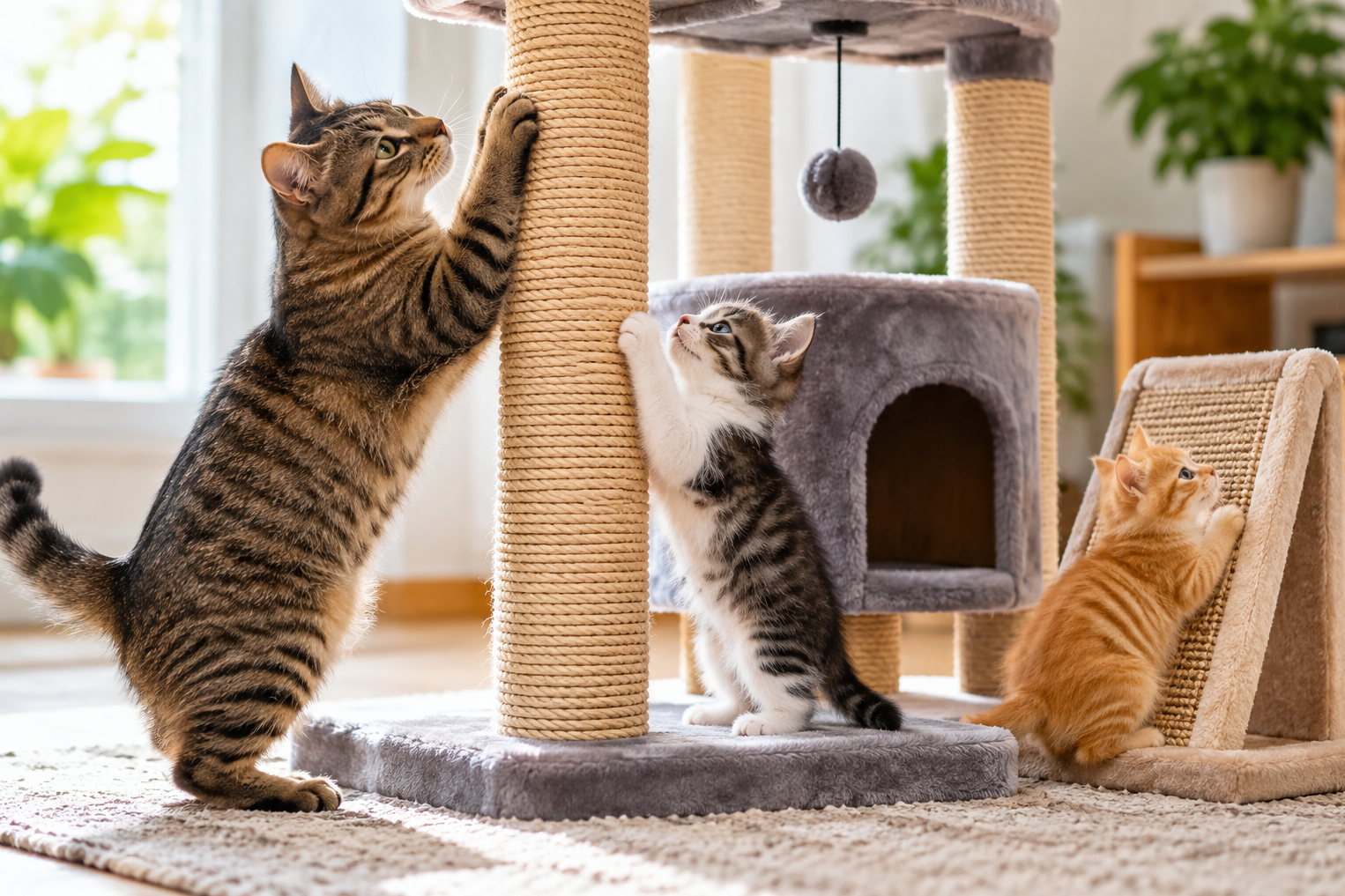
Cat Scratching Posts: Why Scratching Matters and How to Choose the Right Scratcher for Kittens and Cats
Scratching is a natural and important part of a cat’s everyday life. From curious kittens to adult cats, felines scratch for several reasons, including maintaining their claws, stretching their bodies, exercising, releasing energy, and communicating through scent and visual marks. Providing an appropriate cat scratching post or cat scratcher gives cats a healthy outlet for this instinct while helping protect sofas, carpets, curtains, doors, and other household surfaces.
A cat that scratches furniture is not necessarily being destructive or disobedient. Scratching is an instinctive feline behavior. Cats have scent glands around their paw pads, so scratching can leave behind both a visible mark and a scent signal. The behavior also helps remove the outer layers of the claws and gives cats an opportunity to stretch their shoulders, back, legs, and paws.
For this reason, the goal should not be to stop a cat from scratching. Instead, owners should redirect the behavior toward an appropriate scratching surface.
Why Do Cats Scratch?
One of the primary reasons cats scratch is claw maintenance. As the outer layers of the claws become worn, scratching helps remove those old layers. The resistance provided by a suitable scratching surface makes this process natural and satisfying.
Scratching also provides physical exercise. When a cat stretches against a vertical scratching post, it can extend its front legs and engage muscles throughout its shoulders, back, and limbs. This combination of stretching, movement, and claw activity can be particularly useful for indoor cats that may have fewer opportunities to climb and explore.
Another important function is communication. Scratching can leave both visual and scent markings. This helps explain why cats often return to specific locations or choose prominent objects such as furniture, doorways, and other frequently used areas. From a cat’s perspective, these locations may be important places for leaving territorial information.
Why Kittens Need a Scratching Post
Introducing a kitten scratching post at an early age can help establish appropriate scratching habits. Kittens naturally explore their surroundings with their paws and claws, so giving them a suitable surface provides an opportunity to learn where scratching is acceptable.
A kitten scratching post should be stable, appropriately sized, and easy for the kitten to access. Because kittens may climb, jump, and play around their scratching equipment, the structure should have a secure base and should not contain loose components that could become hazardous.
Regularly inspecting a kitten’s scratcher is also important. Damaged parts, loose strings, unstable structures, or other potentially dangerous components should be repaired or removed.
Stability Is One of the Most Important Features
A scratching post that moves or tips over when a cat uses it may quickly become unpopular. Cats often put considerable force and body weight into scratching, particularly when stretching vertically. A stable structure allows them to scratch confidently without worrying about the surface moving beneath them.
A heavy base or securely mounted scratching post can make a significant difference. Larger and stronger cats may require a sturdier construction than small kittens.
The best design is not necessarily the largest or most expensive product. What matters is whether the scratcher remains secure while the individual cat is using it.
Choose the Right Height
Many cats prefer vertical scratching because it allows them to stand on their hind legs and stretch their bodies upward. A vertical cat scratching post should therefore be tall enough for the cat to extend comfortably.
A post that is too short may prevent the cat from achieving a satisfying full-body stretch. Larger adult cats may need taller and stronger posts, while a young kitten may be comfortable with a smaller option.
Observing the cat’s existing scratching behavior can help determine the appropriate size.
Vertical, Horizontal, or Angled Scratchers?
There is no single scratching position that every cat prefers. Some cats like to scratch vertically, while others prefer horizontal scratching pads or angled surfaces.
If an owner has not yet discovered a cat’s preference, offering more than one style can be useful. A tall vertical scratching post can accommodate cats that enjoy stretching upward, while a horizontal cardboard scratcher can provide an alternative for cats that prefer scratching along the floor.
Providing different orientations allows the cat to choose naturally rather than forcing it to use a particular design.
Choosing the Right Scratching Material
The texture of a scratcher is just as important as its shape. Common materials include sisal, cardboard, carpet, and wood. Different cats can have very different preferences.
A cat that ignores one scratching post may not necessarily dislike scratching. It may simply dislike the material, texture, orientation, or location of that particular product.
Sisal Scratching Posts
A sisal cat scratching post is a popular option because sisal provides a rough and durable surface. Cats can pull their claws through the material while scratching, making it suitable for repeated use.
A properly constructed sisal post can withstand considerable scratching and may be particularly useful for cats that prefer vertical surfaces.
Cardboard Scratchers
A cardboard cat scratcher provides a different texture and is often attractive to cats that enjoy tearing and shredding. Horizontal cardboard scratchers can be particularly suitable for cats that prefer floor-level scratching.
Cardboard products may wear out more quickly than heavy-duty posts, but replaceable inserts can make them convenient and practical.
Carpet and Wood
Some cats enjoy carpet or wood surfaces. However, owners should consider whether the material resembles surfaces they do not want the cat to scratch.
For example, if a cat already scratches household carpets, introducing a carpet-covered scratcher may reinforce its attraction to similar flooring. In such situations, experimenting with a distinctly different texture, such as sisal or cardboard, may be more useful.
Where Should You Put a Cat Scratching Post?
Location can be just as important as the design of the scratcher.
A scratching post hidden in an unused corner may receive little attention, even if it is well constructed. Cats often scratch in locations that are important to them, such as near sofas, doorways, sleeping areas, or other frequently used parts of the home.
One effective approach is to place the scratcher close to an area where the cat already scratches. If a cat repeatedly scratches one side of a sofa, for example, putting the scratching post directly beside that location can make the alternative easier to discover.
Scratching posts can also be placed near favorite sleeping areas. Cats frequently stretch and scratch after waking from a nap, making this a natural opportunity to encourage use of an appropriate scratching surface.
Once the cat consistently uses the scratcher, it may be possible to move it gradually to another location. Moving it too quickly, however, can cause the cat to return to the original furniture.
How to Encourage a Cat to Use a New Scratcher
Introducing a new scratching post should be a positive experience. Toys can be placed near the scratcher, and some cats may respond to catnip. Gentle praise or a small reward can also reinforce the behavior when the cat voluntarily investigates or uses the scratching surface.
The important point is to encourage the behavior rather than force it.
Forcing a cat’s paws against a scratching post can create a negative association and may cause the animal to avoid the scratcher. Allowing the cat to discover the surface naturally, followed by positive reinforcement, is generally a better approach.
Avoid Punishment for Unwanted Scratching
Punishing a cat for scratching furniture is unlikely to solve the underlying problem. Scratching is a biological behavior, and yelling or physically punishing the animal does not remove its need to scratch.
Fear-based responses may also damage the relationship between the cat and its owner without teaching the cat where scratching is appropriate.
Instead, owners should redirect the behavior. Make the desired scratching surface attractive and accessible while temporarily protecting furniture that is being damaged.
Covers or other suitable barriers can make a sofa or other vulnerable surface less appealing while the new scratching post is introduced nearby.
Multiple Cats May Need Multiple Scratchers
Homes with several cats may benefit from having more than one scratching location. Individual cats can have different preferences and may not want to share a single scratching resource.
Providing several posts and pads in different areas of the home gives each cat more opportunities to find a comfortable surface and can reduce competition.
A combination of vertical and horizontal scratchers can be particularly useful in multi-cat households.
Scratching as Environmental Enrichment
A cat scratcher is more than furniture designed to protect a sofa. Scratching provides physical movement, stretching, coordination, sensory stimulation, and an opportunity for natural behavior.
Some cat trees combine scratching posts with climbing platforms, resting areas, toys, and hiding spaces. These multifunctional structures can be valuable for indoor cats that need additional opportunities for exercise and exploration.
However, a simple scratcher can be just as effective if it matches the cat’s preferences. The most expensive or elaborate product is not automatically the best choice.
Should a Worn Scratcher Be Replaced?
Not necessarily.
Some cats actually prefer well-used scratching posts because the worn surface provides good resistance and allows them to grip the material effectively. Familiar scent can also make an established scratching area attractive.
However, normal wear should be distinguished from structural damage. If a scratching post becomes unstable, develops dangerous exposed components, or contains loose pieces, it should be repaired or replaced.
The objective is to preserve the scratching experience while keeping the structure safe.
Scratching Does Not Replace Nail Care
Scratching and routine nail care serve different purposes. Nail trimming can reduce the sharpness of claw tips, but it does not replace the behavioral and physical functions of scratching.
Cats still need opportunities to stretch, scratch, exercise, and communicate through normal scratching behavior. Appropriate scratching surfaces should therefore remain part of regular cat care.
Why Declawing Is Not a Solution
Declawing should not be viewed as a simple way to prevent furniture damage. It is not merely the removal of a cat’s nails; it involves removing part of the cat’s toes.
Providing suitable scratching posts, maintaining regular nail care, improving environmental enrichment, and using positive behavior management are more appropriate ways to manage normal scratching behavior.
When Excessive Scratching May Need Attention
A sudden or unusual increase in scratching can sometimes be associated with environmental changes, anxiety, or territorial conflict.
If unusually intense scratching occurs together with other changes in appetite, social behavior, or general behavior, discussing the situation with a veterinarian can help determine whether an underlying medical or behavioral issue should be considered.
How to Choose the Best Cat Scratching Post
The best cat scratching post is not necessarily the product with the highest price or the most features. The right choice depends on the individual cat.
Owners should consider the cat’s size, strength, preferred scratching direction, favorite texture, and existing scratching habits. A large adult cat may need a tall, heavy-duty post, while a kitten may prefer a smaller and easily accessible scratcher.
It is also useful to observe where the cat currently scratches. A scratcher placed in the right location and designed around the cat’s existing preferences has a much better chance of becoming part of the animal’s daily routine.
For many households, the ideal setup may include several options: a tall vertical sisal post for stretching and vertical scratching and a horizontal cardboard scratcher for floor-level scratching.
Scratching is a normal and important behavior for cats. It supports claw maintenance, stretching, physical activity, sensory stimulation, and communication. Rather than trying to eliminate scratching, cat owners should provide suitable places where the behavior can occur safely.
For kittens, a stable and appropriately sized kitten scratching post can help establish good habits from an early age. Adult cats may benefit from taller, stronger scratching posts that match their size and preferred scratching style.
Observing the individual cat is the best way to find the right solution. Pay attention to where the cat scratches, whether it prefers vertical or horizontal surfaces, which textures it enjoys, and how much force it uses.
With the right combination of location, stability, texture, size, and positive reinforcement, a cat scratching post can protect household furniture while giving cats a healthy, rewarding place to express one of their most natural behaviors.